

MANCHESTER, NH–March 24, 2026–A move to amend the $290 million dollar bond approved to build the Manchester School District’s “Phase One” facilities plan was stymied by misinformation from Mayor Jay Ruais, at the March 17 meeting of the Board of Mayor and Aldermen.

Sapienza: Pitching to protect the taxpayers
Ward 8 Alderman Ed Sapienza made a motion to amend the bond, approved on December 5, 2023, to lower it by the $62.6 million the district has spent in cash from its operating budget during the current and past two fiscal years. The amendment would have capped the bond at $227.4 million, ensuring that the district couldn’t spend more money on the project than originally budgeted.
After making his motion, Ruais asked deputy city solicitor Peter Chiesa to weigh in on the motion. “I don’t believe that a bond resolution that’s already been passed can be amended,” said Chiesa. Following Chisea’s comments, Ruais said it was his understanding from the first meeting of 2024 that bond’s cannot “be reconsidered” within five years of their approval. Chisea confirmed that recollection, after which Ruais then went on to then say that after all “the legwork they had done,” they could not “rescind” a bond within five years.
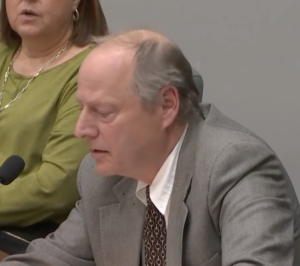
Chisea: Dispensed incorrect information
Sapienza quickly moved on saying, “Very well, so we can’t do that. Great,” then explained that his goal was to ensure that the district didn’t get more money for the project than the board had originally approved.
The responses from Chisea and Ruais, however, were not relevant to the motion Sapienza made to amend the bond. Ruais’ redirection of the point from amendment to reconsideration or rescission was improper. Reconsideration is a specific motion where the board would vote on whether or not to revisit issuing the bond. If the motion passed, the board would then debate and vote again on the question of whether or not to issue the bond. A vote to rescind the bond would be the board voting not to issue the bond. Neither was Sapienza’s motion.
Believing the board had been misled by Chisea and Ruais, Girard at Large asked city finance director Sharon

Ruais: Misrepresented Sapienza’s motion
Wickens if bonds could be amended. Her answer was simple. “A bond resolution can be amended,” she wrote, adding, “While amendments are permissible, any change to the authorized dollar amount must be reviewed by both the City’s financial advisor and…bond counsel. It is essential that the revised amount continues to support the full cost of the project.”
Following the rejection of his motion by the mayor, Sapienza asked, “What’s to prevent them (the school district) from spending the $290 million bonded in addition to the cash” they’ve already spent? Wickens answered, “I issue the bonds. There’s not a chance they’re getting more than they need.”
“Not a chance?” Sapienza asked.
“Not a chance!” Wickens answered.
In comments following another question from Sapienza, Wickens said, “If all goes according to plan, they’ll be bonding $231 million, not $290 million because they’ve paid down, they’ve used the cash.”

Wickens: Not a chance!
In response to questions posed by Girard at Large, Wickens explained when a bond is approved, the amount approved is a “not to exceed” number. “The City is not required to issue the full amount authorized, but it cannot exceed that limit,” she wrote. “Any difference between the long‑term bonds ultimately issued and the authorization amount lapses at issuance. For this reason, I am not aware of any instance during my tenure in which a bond resolution has been amended.”
One golden nugget of information surfaced from Sapienza’s motion and Girard at Large’s questions to Wickens has direct bearing on the school budget. In the budget the district claims is “tax cap compliant,” (It’s not!) there’s a $16.6 million facilities project line item. Comments made previously by Superintendent Jennifer Chmiel indicated half that amount could be “cut” or redirected elsewhere in the budget because the district will be making an interest only payment on the project bonds. Wickens confirmed that the district will be required to pay $7,390,102 in interest on the bonds issued to support the project, meaning the district could remove over $9.2 million from its budget without affecting operations in any way. This is important information given the district’s threatened reductions in spending to close what it alleges is a $16 million budget “shortfall” caused by the city’s tax cap.
When asked why she didn’t correct the misinformation given during the meeting, Wickens told Girard at Large “When Ed made the motion to amend, I intended to respond; however, the Mayor interpreted his motion as a recession, and Ed did not correct him. At that point, I believed it was my misunderstanding.”

Chmiel: Has over $9 million in budget that won’t be used on debt
Before making his motion, Sapienza announced his request to put the item on the agenda had been “rejected” and that was why he was raising it under the New Business section of the board’s agenda. Several minutes later, Ruais, said he didn’t put it on the agenda because he figured it would be discussed at the joint meeting of the BMA and Board of School Committee and he only wanted to have the conversation once, despite saying that the motion could not legally be made earlier in the meeting.
For those not in the know, the original budget for “Phase 1” of the school board’s facilities plan, which includes putting massive additions onto the city’s four middle schools, despite their having excess seats and declining enrollment, and the construction of a 750 student elementary school across the street from the existing Beech St. School to hold the populations of both that school and the now closed Henry Wilson School.
Bonding is the issuance of debt by the city to raise funds for projects. The city pays interest on that debt. The bond in question will cost taxpayers approximately $16.6 million per year for the next 30 years, for a total cost of $498 million. The school district’s current line item for debt repayments is about $11.5 million so this project nearly triples the amount of money being spent and debt.