
Amidst claims of calamity, district avoids publishing state required financial data

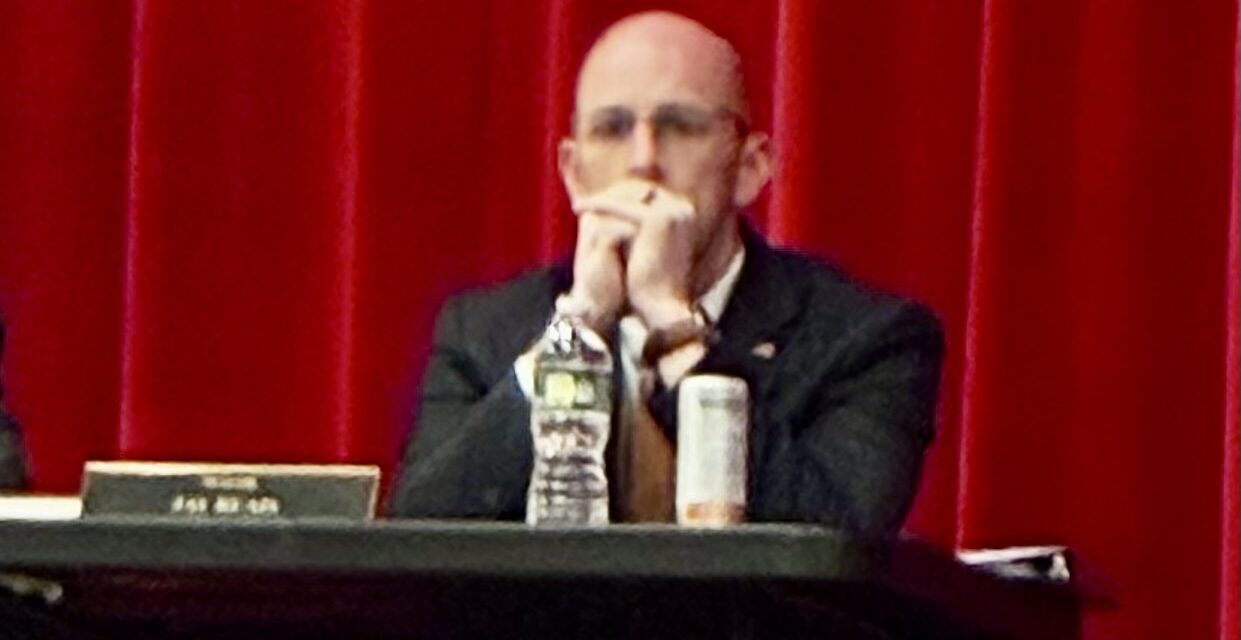
Murphy: The law applies to all.
MANCHESTER, NH. April 19, 2026–Following a public hearing on the city of Manchester budget, which included dozens of organized speakers in favor of substantially higher school spending and the taxes needed to pay for it, Girard at Large discovered school administrators are intentionally withholding budget information mandated by a new state law from the Board of Mayor and Aldermen (BMA) and the public.
The law, known as the Students First Act, became effective on July 1, 2025. Sponsored by Manchester Senator Keith Murphy (R-District 16) to improve school budget transparency, the act requires school districts to publish the following data for the previous 10 years in a report entitled “Mandatory Report to Voters on School Expenses:”
- Average cost per pupil
- Average teacher salary
- Administrator salaries.
The law specifies how the information must be presented, where it must be posted and when it must be made available to the public.
During the April 14 public hearing, former at-Large School Committeeman Rich Girard, the publisher of this blog, mentioned the law. While he didn’t think it applied to the city, he suggested the BMA request not only the information specified in the law but also historic information regarding the number of teachers, principals and assistant principals and district office administrators at the level of “Directors and Coordinators” and above. Girard said that discussions over funding were futile if the BMA didn’t know where the money was going and what results were being had.
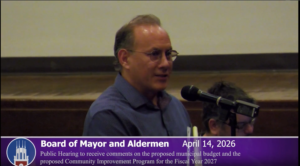
Girard: Calls on BMA to obtain data
After testifying, Girard received a text from Murphy, whom he had contacted earlier in the day, stating that the law applied to all school districts in the state. As a result, Girard sent the law to school district legal counsel Matthew Upton at 12:54 PM on April 15 and asked “the district provide the required information in the format established by the law along with an explanation as to why the district has not followed it.” The email was copied to Superintendent Jennifer Chmiel.
On Thursday April 16 at 2:51 PM Upton replied, writing:
Rich:
The district is fully aware of RSA 189:76. There is a legitimate question of whether or not RSA 189:76 even applies to city school districts. The entire premise behind this law is to inform voters prior to their adoption of the budget at the annual town meeting. In fact, the report that is required is entitled “Mandatory Notice to Voters on School Expenses”.
RSA 189:76 requires the report to be disseminated seven (7) days in advance of any meeting at which the “district” is “adopting” a budget. There is no meeting where the “district” adopts a budget. There is a meeting where the Board of Mayor and Alderman (BMA) adopt the school district budget pursuant to Section 6.04 of the City Charter. There is also a meeting where the BOSC formulates a tax compliant budget for consideration by the BMA. However, neither of these meetings technically meet the definition of the statute.
Nonetheless, the district decided a few months ago to provide the report required by RSA 189:76 prior to the meeting at which the BMA adopts the school district budget because it bears the closest resemblance to a meeting where the district adopts a budget. To date, the district has not been notified as to the meeting date at which the BMA intends to adopt the school district budget. The latest estimates are that the meeting will likely occur in the later part of May 2026. The district intends to provide the report within the timeframe required by law.

Upton: District is waiting, law is questionable
Since the BMA does not have a date on which a “binding vote to adopt the district’s budget” will take place, the question becomes: “What constitutes compliance?” Should the information have been made available when the school board voted on the budget? Before Mayor Jay Ruais released his budget proposal? Before the public hearing on the budget? Before the BMA votes?
Girard at Large immediately inquired of Upton and Chmiel why they were potentially waiting several weeks to release the data:
Hi, Matt:
Thanks for the reply. It’s good to know the district intends to comply. That said, as we know, when the Board of Aldermen votes on the school district’s budget is always a bit of an unknown and it’s not unusual for it to be taken off the table and voted on in the heat of the moment.
Given all of this, why not simply distribute it now so that it is available for all of the discussions that will be had over the next several weeks as the aldermen deliberate on the budget? Is there a specific reason why this information is being withheld until 7 days before a vote, assuming you’ll know when a vote is planned?
Absent some rational reason for waiting, it may appear as if the district is delaying the production of this material to avoid what might be inconvenient visuals that might challenge the narrative of how it’s been deprived of funds in recent years.
Planning a story for early next week. Hoping to have the material. If not, answers to these questions will be included in the article.

Ruais: No response to either email
No response has been received from either Upton or Chmiel.
Because Upton copied Ruais on his response, Girard at Large subsequently emailed Ruais asking the following:
Your Honor:Do you believe the district should provide this information? If so, do you believe they should do so now or wait as per their suggestion? Article to be published early next week.
As with Upton and Chmiel, Ruais did not reply.
Girard at Large shared Upton’s email with Murphy who sent it to Ian Huyett, legal counsel for Cornerstone Policy Research, a non-partisan, non-profit Christian advocacy organization that helped draft and pass the law. Huyett wrote:
I think what Upton calls a “legitimate question” is basically a weaselly argument. Voters usually decide to adopt the budget, but nobody thinks this means “the district doesn’t actually adopt a budget.”
Wadleigh, Drummond, and other education lawyers have all interpreted the law to require posting seven days before any kind of binding vote to adopt a district budget. So far, whenever I’ve threatened for a client to sue noncompliant districts, they’ve all complied with the law.

Huyett: Weasel words
Concurrent with the release of that email, Murphy issued a statement issued to Girard at Large which read:
It was my intention as the sponsor of legislation to have it apply to all school districts across the state. If Manchester believes it does not apply to its district, then I will have to look at filing a bill next year to address the issue.
Upton’s assertion that the district doesn’t need to provide the information more than 7 days before the BMA votes on the school board is problematic for several reasons.
First, the occasion is rare, if non-existent, when a board agenda includes a “final vote” on either the city or school budget. Normal practice is the to table the appropriating resolutions after the public hearing and leave them aside while elected officials hash out various changes behind closed doors. When those clandestine conversations have achieved a consensus, the item is taken off the table without much, if any, prior notice and amendments are made to enact the deals made behind closed doors.
Second, Upton said that the district would send the state required data once it had been notified by the BMA that a vote was scheduled. Said another way, if the BMA doesn’t notify the district of the vote, the district won’t send the information. It should be noted that the BMA has never notified the school district of the date on which it intends to vote on its budget. Upton’s language is designed to blame the aldermen for failure to notice them so as to absolve it of it’s legal responsibility to transmit the required report.
Third, and perhaps most importantly, refusing to release the information deprives the aldermen and the public of historic data that puts a spotlight on the district’s spending. The district and its supporters have orchestrated a coordinated campaign, including fliers that were handed out to participants at the public hearing, to advance a narrative that not only portends disaster if the district’s budget demand aren’t met, but also slams the city for “chronic underfunding” over a period of years.
Critics of the district have pointed out the nearly $50 million increase in spending, a spike of approximately 28%, over the past three fiscal years, and chastised the district for spending it on pay raises and unnecessary school building projects, while draining emergency reserves and failing to allocate dollars to classroom supplies and curricular materials.

MSD: Where IS the money going?
Regardless of one’s interpretation of the law, two questions remain:
- Why is the district withholding the information until an undisclosed future date, which may never come because of the way budgets are often adopted?
- Will the BMA require the district to provide, at a minimum, the information included in the state law and those items suggested by Girard to understand where the schools have spent taxpayer dollars?
Click here for the email sent by Girard, a former chairman of the school board’s finance committee, to the BMA to follow up on his testimony about the Students First Act and suggest budget data it should request from the district before voting on the school budget.