

Proposal hikes tax rate by 12%,
increases taxes raised by almost triple the Tax Cap
MANCHESTER, NH May 15, 2026–Manchester aldermen Jim Burkush (D-Ward 9) and June Trisciani (D-at-Large) released a proposed “Aldermen’s Budget” to members of the Board of Mayor and Aldermen in an email sent late Friday afternoon. Girard at Large obtained the email, which included documents showing the two Democrats reversed, without exception, every spending reduction proposed by Mayor Jay Ruais to keep his budget proposal within the confines of the city’s Tax Cap.
 The Tax Cap, which is enshrined in the City Charter, limits the amount of new property taxes that can be raised from one budget to the next to the three year average of the National Consumer Price Index – Urban. In Fiscal Year (FY) ’26, the current fiscal year, the city raised $269,815,614 million in taxes. This year’s cap on the amount of new taxes that can be raised 3%. That means the city can increase taxes for FY ’27 by $8.094,468. ($269,815,614 x .03 = $8,094,468)
The proposal from Trisciani and Burkush increases the amount raised in taxes from $269,815,614 to $291,909,010, a staggering increase of $22,093,396 or 8.2%
In addition to wiping out $3,566,652 million in spending reductions made by Ruais to departmental budgets, the Aldermen’s Budget added $3,034,564 to employee benefits, hiking spending on health insurance, city and state retirement pension payments, and casualty insurance. Much of this increase comes from their funding vacancies and other positions the mayor defunded.
But that’s not all. Trisciani and Burkush nearly doubled the amount in the contingency account, which is used for unexpected expenses, adding $1,670,840. They also increased the amount of cash for capital projects by $1,650,000, a more than ten fold increase over the mayor’s proposed $160,000. The overlay account, which is used to pay abatements on property taxes, was increased by $400,000, more than 27%

Burkush
All totaled, Trisciani and Burkush hiked spending on city operations from $201,366,017 in the current budget, to $210,608,344, an jump of $9,242,327 or 4.6%. Municipal taxes raised to support this spending spike went from $133,499,632 to $149,266,521, a stunning increase of $15,766,889 or 11.8%, caused not just by the spending increases, but projected losses in non-tax revenues of $6,524,562, including the disappearance of one time revenues that were used to expand operating expenses in last year’s budget. Under the tax cap, these losses must be paid for by any new property tax revenue before spending can be increased. Clearly, they weren’t.
In addition, Trisciani and Burkush increased school spending by $4 million over Ruais’ budget, bringing the school district’s operating budget to $238,981,749, an increase of $981,824 or 0.4%, over the district’s current appropriation of $237,999,925. To fund this increases, the local education tax jumps by exactly $7 million, from $117,531,711 to $124,531,711 or 6%. This not only covers the spending increase, it covers the loss of $6,018,176 in non-tax revenues, including reductions in state aid due to yet another projected drop in student enrollment. As with the “city side of the budget, this also violates the tax cap for not offsetting requires the loss of non-tax revenues before spending can increase.
Analysis:
How they’re lying about the Tax Cap
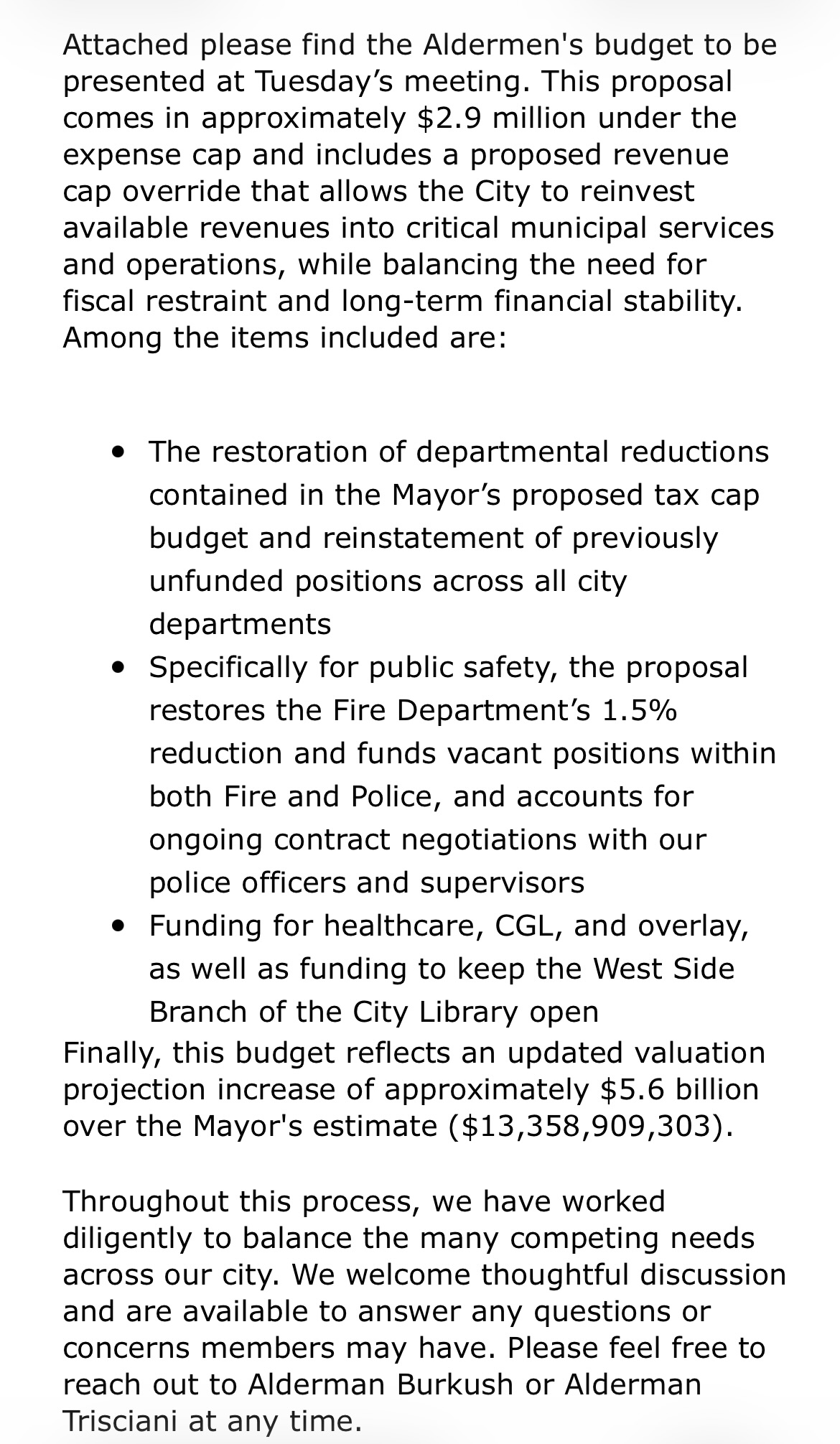
the email, click to enlarge
In their email to the mayor and aldermen, Trisciani and Burkush say their budget:
“…comes in approximately $2.9 million under the expense cap and includes a proposed revenue override that allows the city to reinvest available revenues into critical municipal services and operations, while balancing the need for fiscal restraint and long-term financial stability….Finally, this budget reflects an updated valuation projection increase of approximately $5.6 billion over the Mayor’s estimate.”
To start, we have asked Trisciani and Burkush to cite the provisions that create an “expense cap” or provide for a “revenue override,” since we cannot find any such provisions in the City Charter or Code of Ordinances.
Charter Section 6.15, entitled Limitation on Budget Increase, provides as follows in subsection A4:
In establishing a combined municipal budget, the board of mayor and aldermen shall assume estimated property tax revenues ONLY in an amount NOT TO EXCEED property tax revenues raised, excluding property tax revenues raised for amounts payable in connection with municipal bond obligations, during the prior fiscal year increased by a factor equal to the average of the changes in the National Consumer Price Index – Urban as published by the United States Department of Labor for the three (3) calendar years immediately preceding the year of the budget adoption. (Emphasis added.)
It then goes on to say that if the average is negative, then the increase in taxes “shall be zero.” The layman’s version of the above citation is simply this: You multiply last year’s amount of taxes collected by the three year average of inflation to determine how much the city can raise for the new fiscal year. Here’s the math for this budget:
- Taxes collected in FY 26: $269,815,314
- 3 year average of inflation: 3% (.03)
- $269,815,314 x .03 = $8,094,459.42
- TOTAL TAXES TO BE RAISED BY THE TRISCIANI-BURKUSH “ALDERMEN’S BUDGET”
- $22,093,396
- ($22,093,396/$269,815,614) x 100 = 8.188% increase in taxes. (Note: $269,815,614 is what was raised in FY ’26)
- That’s almost TRIPLE what’s allowed under the cap.
- THIS REQUIRES A TAX CAP OVERRIDE…NOT A “REVENUE CAP” OVERRIDE.
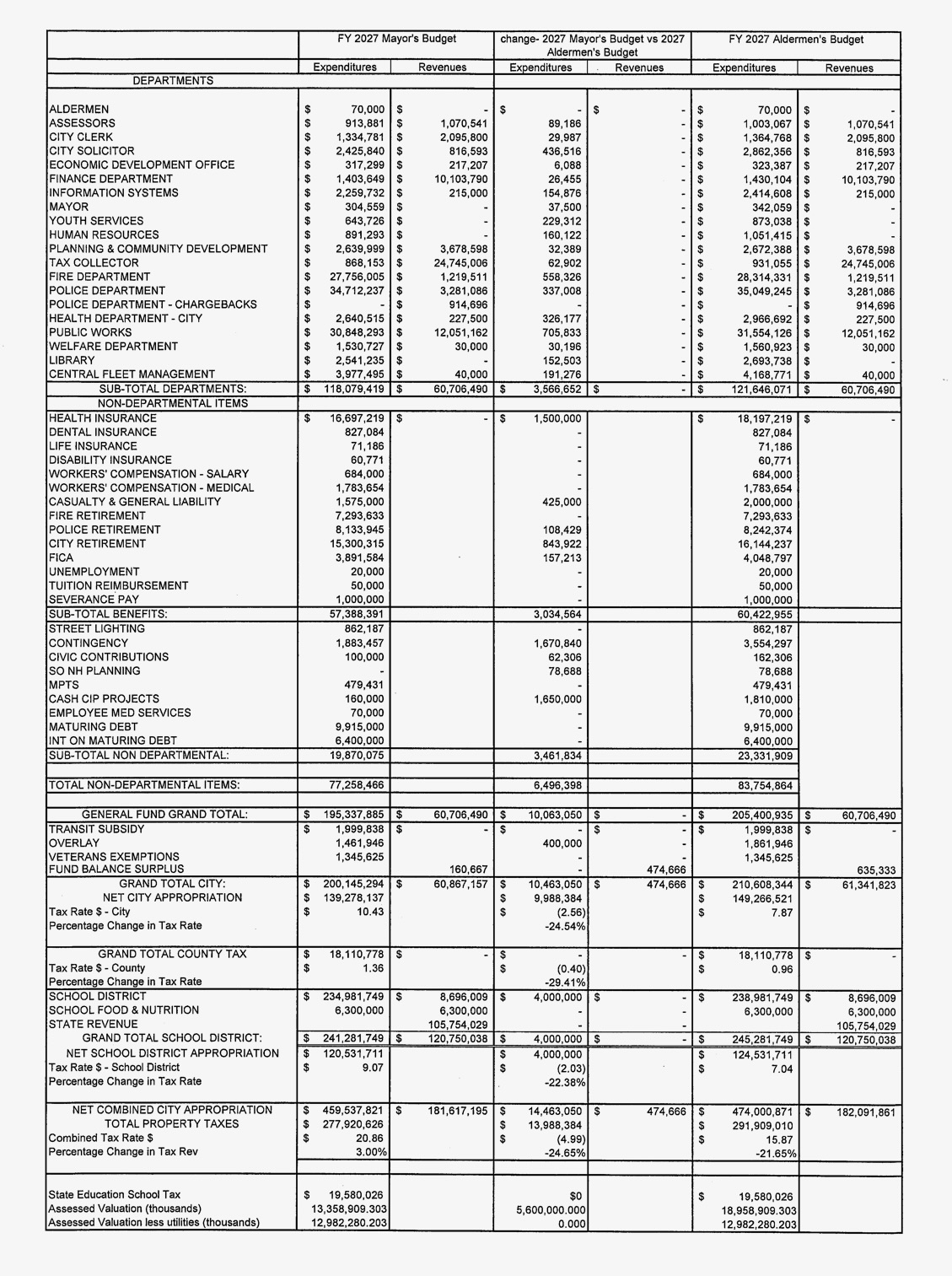
Aldermen’s deceptive budget, click to enlarge
The charter specifically addresses how to apply the tax cap in a revaluation year. It reads as follows in Section 6.15 C:
Budget limitation in revaluation year. When there is a citywide revaluation, the board of mayor and aldermen SHALL adhere to the following limitations for a positive or negative revaluation: Property tax revenues raised in the prior fiscal year, excluding property tax revenues raised for amounts payable in connection with municipal bond obligations for the prior fiscal year, SHALL NOT be increased by a factor more than the average of the changes in the National Consumer Price Index – Urban as published by the United States Department of Labor for the three (3) calendar years immediately preceding budget adoption, then this figure SHALL be used in establishing the new municipal budget. (Emphasis added.)
Whether values go up or down in a revaluation, the calculation remains the same. The amount collected in taxes may ONLY go up by the three year average of inflation. Note well, despite the support of then Mayor Ted Gatsas and EVERY member of the Board of Mayor and Aldermen and the Board of School Committee, voters destroyed a proposed charter amendment in 2014 that would have allowed “revenue overrides” for the collection of increased tax revenue from increased valuation. That’s how we know, for certain and beyond dispute, that “revenue overrides” do not exist. The politicians tried to change the charter to allow it and the people said “NO!”
While Triciani and Burkush say their budget is below the “expenditure cap,” the ONLY mention of expenditures in the charter comes in Section 6.15 E:
Total Expenditures. Total expenditures, excluding amounts payable in connection with municipal bond obligations, for any given budget year, SHALL NOT EXCEED the amount of funds reasonably calculated to be derived from property tax revenues pursuant to Paragraph A.4. herein, increased by the other revenues generated by the City. (Emphasis added.)
This means that spending can go up by the total of the amount of new taxes raised under the Tax Cap plus any increases in non-tax revenue. If non-tax revenues decline, as they do in the Aldermen’s Budget, then those loses must be subtracted from any increase in property tax or other revenues. If what’s subtracted is greater than the amount in new taxes, then spending must be cut to make up the difference. This being the actual language of the Charter, it can only be concluded that Triciani and Burkush don’t know how it works or they’re making it up to fool you.
How they’re hiding the tax hike behind the revaluation
First, notice that the Tax Cap does NOT apply to the tax rate. It applies ONLY to the amount of taxes raised in the prior year.

Ruais: Will he or won’t he uphold the tax cap?
Having said that, the relationship between the tax base and the tax rate is direct and proportional. That means by whatever percentage the tax base goes up or down, the tax rate will go down or up by the inverse percentage IF the amount of taxes raised doesn’t change. The formula is basic:
Tax Base x Tax Rate = Tax Revenue
It’s already been demonstrated that the Triciani-Burkush budget increases tax revenues by a staggering 8.2%. That said, the tax rate increase is even bigger than that. Here’s how it works and why.
To determine the increase in the tax rate from FY ’26 to FY ’27, we divide the FY ’26 tax revenue by the FY ’27 tax base to calculate the adjusted tax rate for FY ’26. If Base x Rate = Revenue, then Rate = Revenue / Base. It’s a basic equation that equalizes the tax rate from one year to the next to make a tax rate comparison possible because Trisciani and Burkush are using an estimated tax base for FY ’27.
So, dividing FY ’26 Tax Revenue by the projected FY ’27 Base equalizes the FY ’26 Tax Rate by DRAMATICALLY lowering it.
$269,815,614/$18,958,909,303 =0.0142
Now we multiply that amount by 1,000 to get the tax rate, because our tax rate is per thousand of value.
0.0142 x 1,000=$14.20
$14.20/1,000 is the equivalent tax rate for FY ’26 for comparison to FY ’27.
The tax rate in the Triciani-Burkush budget is $15.87. $15.87 – $14.20 = $1.67. That $1.67 increase is an 11.8% tax increase (1.67/14.20=0.118) OVER FY ’26.
Triciani and Burkush show the tax rate going down by 21.65%. Why? Because they’re comparing the FY ’27 tax rate to the FY ’26 rate without equalizing the tax base values.
Since Revenue divided by Base equals Rate ALWAYS, if we divide the Triciani-Burkush tax increase of $22,093,396 by the current tax base of $13,358,909,303, we get a tax rate increase of $1.65, an 8.2% jump.
No matter how the numbers are equalized, the result is the same: A stupefying increase in taxes and a breathtakingly dishonest trampling of the Tax Cap.
 Oh, and one more thing; the Triciani-Burkush “Aldermen’s Budget” compares itself to the mayor’s proposed budget, not the current FY ’26 budget. By comparing their proposal to the mayor’s, they’re deceiving taxpayers as to the size of their huge tax and spending increases because they’re padding the current budget with the mayor’s proposed budget to make their increases look smaller.
Wondering how much the tax rate would fall by using the new base value and not raising taxes? The answer is above. The tax rate would fall to $14.20. Here’s how to calculate the decrease based on that:
$20.24 – $14.20 = $6.04 the current tax rate minus the equalized tax rate.
$6.04 / $20.24 =0.298
0.298 x 100 = 29.8%
The tax rate would plummet by 29.8% IF taxes weren’t raised. But, they are being raised, by a lot, which is why they’re being deceptive in their presentation and dishonest about the math.
If the mayor and Board of Aldermen followed the tax cap, taxes would go up by no more than $8.094,468 and overall spending would be CUT by $4,48,270 because the cap requires the total revenue losses of $12,542,738 to be subtracted from the $8,094,468 in new taxes raised. That’s a negative number has to be made up on spending cuts, as shown above.
Conclusion
The simple truth is this: To pass this budget, there must be an override of the tax cap to authorize increasing taxes by more than the $8.1 million allowed to under the cap and to increase spending beyond the losses of non-tax revenue. The charter provides for that in Section 6.15 A2:
Override Provision. Budgetary restrictions described in any part of Section 6.15 may be overridden upon a vote of two-thirds (2/3) of all aldermen elected. Such override only applies to the budget then under consideration. Supplemental appropriations require two-thirds (2/3) override votes, or the limitations expressed in this section will apply. (Emphasis in the original.)
Craig: A comparative amateur
This means this budget needs ten votes on the Board of Aldermen to override the Tax Cap, regardless of how many aldermen are present. When the motion is made to override the cap, it won’t be to override the “revenue cap;” it never has been despite the use of this rhetoric in the past. It will be to override Section 6.15 of the City Charter, as it always has been. They should just be honest about what they’re doing. If they had any integrity, they would be.
The giant tax spike proposed by Trisciani and Burkush in the Aldermen’s Budget is a broadsword pointed at the heart of Manchester’s taxpayers. This will make what Mayor Joyce Craig and the Democrats did for FY ’22, which used the last revaluation to hide an increase in taxes, look like amateur hour.
At the time of publication, neither Trisciani nor Burkush responded to our emailed questions. We also asked Mayor Ruais if he would support this budget or veto it and rally the GOP aldermen to sustain his veto. He did not reply. If any of them respond, we will update this article.